None of this ever happened, if anyone asks. One hundred per cent fiction.
Right. Now that the lawyers are satisfied, let me tell you about her. She was three-and-three-quarter years old, born in the tumultuous November of 2020, a year of plague, and her presence in my house owed something to the mysterious life-altering power of the pandemic.
Like a lot of people in those strange days, I bought chickens. More as a joke than anything else. But surprisingly, everyone liked them. We’d pour seeds on the ground and watch as they pecked like journalists working a typewriter. On cold days, or if anyone left a door open, they would sneak inside, moving nose to tail like a party of explorers, and we would find them in the living room perched by the fire, or tearing open the food bin, or else purring contentedly at the windowsill, resting on their warm feathers like loaves of cooling bread.
One died young. She—there’s no other way of saying this—exploded. After a few hopeless attempts to fix the problem we took her to the vet and the vet said something like, ‘Look, it’s £500 to fix it and £5 to kill it’. The phrase ‘putting it out of its misery’ was bandied about.
If I’d been at the vet that day, instead of at work, I would have tried to pay the £500. But it would have been hopeless. Partly because I’d just put all my money into Bitcoin, which had immediately crashed. And partly because her condition was beyond repair. She was an oozing geezer of strange liquids and alarming smells. So, while Boris Johnson was partying in Number 10, we were attending the socially distanced funeral of our beloved bird, Spice. (RIP Spice.) Then we found out from the internet that chickens have been known to mourn their dead, and that made everything worse.
So, then there were two. One maternal, soft, brave, and one huge, even softer, one of life’s natural babies, afraid of everything, content to obey orders, calling out at the slightest change of wind—beware, beware! This usually meant that there was a cat sitting in the long grass, or an oriental pheasant languidly preening himself at the coop, but her fears of a demon-haunted world were sometimes vindicated. Once, a dog chased her into the house and she hid, trembling, under a computer desk, refusing to emerge from the tangle of wires and sockets even for the pink treats that were her special favourite food. Eventually we lured her out with a sausage, her other favourite food (all food was her favourite food), and from then on she was terrified of dogs in particular. The dog in question was a tiny terrier but to her eye, it must have seemed like a polar bear, massive, fast, full of hysterically yelping teeth, something sent from the depths of Hell.
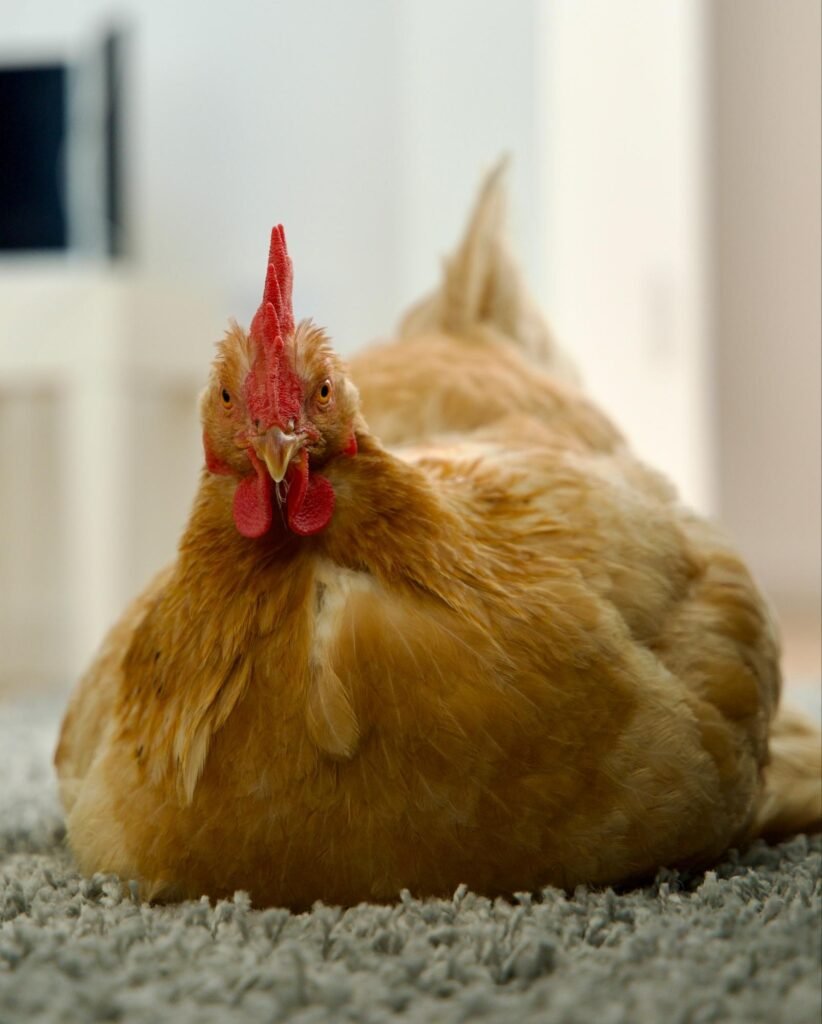
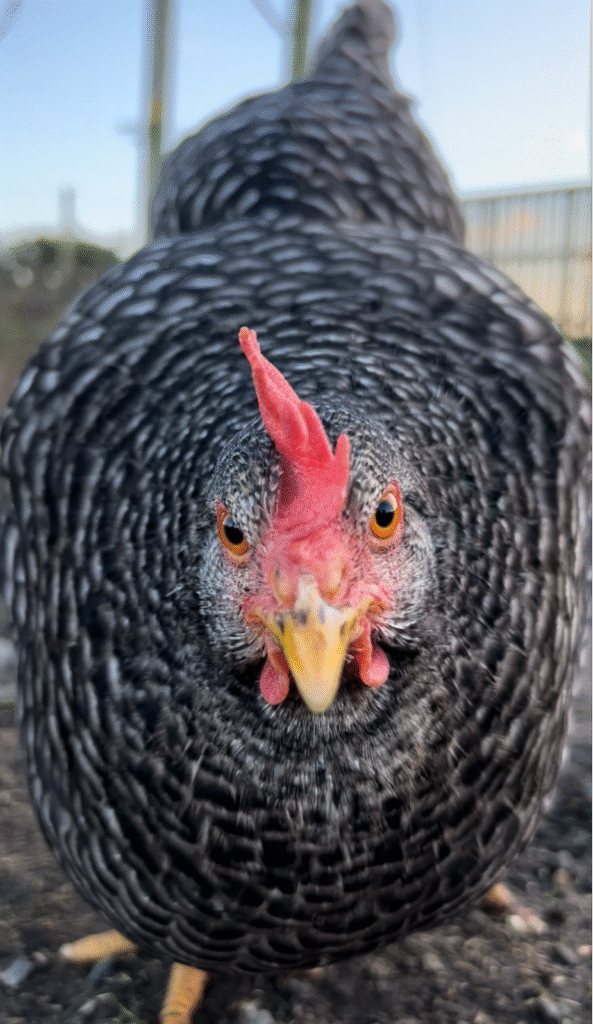
Her name was Mengistu. This was hard to explain to guests, especially Ethiopian ones. So we nicknamed her Precious. Both names were oddly suitable to different aspects of her character: “Precious” for obvious reasons and “Mengistu” because, like the famous dictator, she always looked angry. Her Godzilla eyes glowed orange with passionate rage, and remained fixed in a defiant pose from the day she arrived until the very last picture we took. She no doubt felt that it was appropriate to present to this scary world a scary face. But she never looked scary, not to us. She looked like a very, very fat chicken, almost perfectly circular, though paradoxically from some angles she looked almost noble, like a native American surveying the effects of pollution on his land.
Pumpkin, her sister, would run without a second’s thought to confront or attack almost anything. Once, they came back to the coop to find three or four pheasants helping themselves to the food. Pumpkin made for them immediately. Mengistu stood, contemplating. But something in her said to be brave, and my favourite video of all the videos we took shows her deciding to pick up her wings and run madly round the corner to help confront the intruders.
She was blessed with the kind of plumage that distinguishes royalty in the avian kingdom. She also hated to be picked up, and would vanish like a startled anemone into her own soft under-feathers to escape, paddling with her feet and wriggling her beak from side to side, somehow shimmying through her own body and away. She also developed the odd habit, perhaps borne of a problem with depth perception, of hopping down the stairs with both feet together, landing on each one like a toddler, her face contorted with mental effort—plop, plop, plop. Then she would run to catch up.
Every single day that bird cheered me up. To look over the garden and see her dark tail fin sharking through the bushes was to be, for a while, perfectly happy, and even when she went missing, usually something funny would have happened. She would have ventured too deep into the undergrowth and got stuck, or gone to bed in the wrong coop, or found herself, somehow (and I still don’t know how), inside the wicker garden chair that had been put away for winter. It took about an hour to find her, following the wak-waak of her stern, deep voice. Her voice. In the novel Barn 8, we learn that “All chickens, hell, all birds, are known to each other by individuated chirps—in other words, names.” I don’t think this is entirely sentimental, and I’ll tell you why if you stay to the end.
One day, I found a melon-sized hole under the garden fence. Something had burrowed under and away. I didn’t think much of it. We always knew in the back of our minds, as all responsible chicken owners do, that foxes prowl around looking for unlocked coops. But after three years without incident, the possibility of an attack seemed remote. Foxes lived down in the valley. At night you could hear them scream. (In their coop, the chickens must have heard this, too.) But foxes had never ventured up the hill, preferring, we assumed, to prey on the wild birds that nested on the ground near their burrows.
The next morning she was gone. I wasn’t worried. I knew she’d be inside another item of furniture, or in someone’s house, or laying an egg in some far away bush. I went outside and saw that the straw in the coop had bunched up around the door. A bad sign. I imagined some kind of egg gone wrong, a struggle to lay that had turned into a marathon birthing session. Hens aren’t naturally inclined to lay five eggs a week. Like pigeons they’ve been bred selectively to be as useful as they can be, and that means eggs, too many eggs, great piles and conveyer belts heaving under the weight of eggs of every colour, shape, size. And sometimes the eggs get stuck or worse, burst. You have to rush them to the vet, and the vet says, “Hello again, it’ll be £500 to save it or £5…”
It wasn’t an egg problem. I opened the lid to find feathers absolutely everywhere. I looked hard at the feathers, somehow expecting to find her underneath them, naked. But she was gone. I reached into the straw and pulled out a strip of yellow skin. A line of feathers tracked through the grass to that damned hole in the fence. On the other side, the trail continued down the line of the fence and then vanished in a deep, dark hole that plunged through a thicket of brambles. I plucked a matted feather from the thorns and thought, she was so scared of dogs.
I’ve always been against fox hunting. But as soon as this happened, I found a tweed overcoat in my wardrobe. I wanted to get hold of the fox that did it—or any fox, really—and turn it into a hat. First I would show it a picture of Mengistu (“remember this?”) and then I would pull its ears off. I followed the trail of feathers down through the forest and into the valley, trying in vain to distinguish between the hundred feather-trails that all seemed to converge on a nearby field. A few scratch marks here, a depression in the ground there… but the lair itself was harder to find. It would take days and in the meantime, Pumpkin, who seemed largely unperturbed by the loss of her huge sibling, would have to be made secure in the spare coop. We barricaded her inside and nailed extra planks of wood to the front.
That night we played back the CCTV footage from the night of the attack and found that Pumpkin had escaped (somehow) and run round the house at 2:55am. Hens have worse night vision than we do, and she would have been finding her way alone by moonlight. At 2:57am she reached the other side of the house and sat perfectly still on the lawn for three hours—three hours—until someone opened the back door. Imagine. You’ve never been outside at night before. You know that something wants to eat you. And you’re made of food. We knew Pumpkin was brave but this was something you’d expect to read about in the diaries of Ranulph Fiennes.
When we went out to congratulate her the next morning, we found the wooden panel that had been nailed on was now lying, splintered, on the ground. The flimsy wood was scored with long scratch marks. It had come back. All night, Pumpkin would have tried to stay silent while this thing scratched and gnawed at the thin planks, and when it broke through, she would have seen the black eyes and the white teeth, smelled the musk and the breath. But she was alive. She had looked it in the eyes twice and she had lived twice. That night, understandably, she refused to get back in the destroyed coop. It would have been like climbing back into the Titanic submersible. We built a temporary home for her in the kitchen until the situation had been, let’s say, resolved.
* * *
We found a tunnel. In fact, we found a network of tunnels. All this time our house had been resting on a warren of huge, oval passageways dug into the sandy earth like some Hamas supply line. We set about the tunnel with spades and pick axes—the vaporous sundown found our black silhouettes still hard at work, or maybe I’m half-remembering Raiders of the Lost Ark. We knew that to look into the ark was death… no wait, that’s definitely the wrong story… We kept working, slicing into the cool earth. All along the roof of the tunnel, black spiders moved their sharp limbs and hung white cotton bolls full of eggs. They moved towards us in the dark with fairytale menace. I withdrew my hand and dusted the torch: miles to go.
Some time later, we returned to the dig site. No footprints, no activity. The tunnel felt like a dry-docked boat, abandoned for the season. So we took a walk further down to the valley and, near a farmer’s supply barn, found a tunnel entrance that made us stop. It was clearly active. And huge, more like the home of a caveman than a fox. We strapped a trail camera to a nearby tree and waited.
The next day we had our first glimpse of the killer. And this is where the story gets extremely fictional if you’re an animal rights lawyer. Because it wasn’t a fox. It was a badger.
Meles meles. The mint humbug of death. This had a number of implications, none of them good. First, unlike foxes, which tend to sink their teeth into a bird’s neck and carry the limp carcass back home, the badger starts to eat from the back, tearing and thrashing around like a shark. A far worse death. Mengistu would have heard it scraping those long, black claws along the outside of the coop, and she would have seen the skull-white, Baron Samedi face even in the dark.
Second, badgers have a secret weapon. Thanks to John Major, who brought in the Badger Protection Act of 1992 to stop fun-loving rural types from sending their dogs into badger setts, the badger has more legal protection than a human child. If you disturb a badger sett, or relocate a badger, or kill a badger, you can expect to be landed with a fine not exceeding—close your eyes and guess—£40,000. That, or a year in jail.
So, ignoring the fact that we had already disturbed a badger sett, we were now facing down an animal with diplomatic immunity. We kept the trail camera running, and in the meantime it returned regularly to use our garden as a latrine. Apparently this is an aspect of territory marking. The world’s least endangered animal had returned to tell us that, after eating our prized hen, it now owned our house. ‘Blessed are those who mourn,’ says the Bible, ‘for they will be comforted.’ Turns out, no, they will be mocked and their garden will be covered in giant excrements.
So we bought a gun.
The plan was very simple. Using a night vision monocular that I had bought years earlier, we would stake out the garden and identify the enemy. Then we’d give it the old Shinzo Abe. Sadly, the plan went wrong. It turned out that the gun was barely able to penetrate a sheet of tracing paper, and the night vision was even worse than I remembered. Everything was grey, apart from the occasional green blob that Joe Rogan would accept as proof of extraterrestrials. The UFO would migrate vaguely across the lawn, then meow, revealing itself to be some sort of cat. Hopeless.
Other plans came and went. I wanted to kill it and then take the body to a road and run it over. No law says you can’t accidentally run over a badger. But this would have meant contracting Tuberculosis. Then I hit on the idea of having one person deliver some rat poison to our house, then another person accidentally ‘drop’ the rat poison, then a third person drop a delicious steak on top of the rat poison, then a fourth person move the badger to a shallow grave. Each of these acts alone being perfectly legal.
None of my Agatha Christie ideas seemed to persuade anyone though, so we bought a trap. Obviously you can’t advertise badger traps for sale. And you can’t search for them, either. That would add to the increasingly illegal search history of ‘guns near me’, ‘cheap night vision cameras’, and ‘do badgers die if you run them over’ and put us in jail for fifty years. Given the state of UK legislation, we’d likely be sentenced by a jury consisting entirely of badgers. I imagined all of us in court, including Pumpkin, who had now been living happily in the kitchen for about two weeks.
Eventually we found something advertised as an ‘animal trap’. £100 later we assembled it in the garage. I’ve never seen anything that looked quite so illegal. We had expected a metal box about the size of a briefcase, but the box before us was like something Steve Irwin would have used. No matter. We would cover it in leaves and hope that the largest predator in the country followed its keen sense of smell to our bait: a supermarket chicken. Happily badgers can’t smell irony.
Meanwhile our trail camera continued to record. Pheasants would climb up and in to the sett, presumably harvesting scraps of meat left behind by the (now sleeping) monster. Quite a risk. The mound of raised earth that fronted the burrow was, there’s no other way of putting this, full of bones. Badgers keep their setts clean and have been known to evict less fastidious animals like foxes, with whom they sometimes grudgingly cohabitate. So last night’s dinner would already have been sent windmilling out of the tunnel entrance, adding to the seven foot quarry of splintered cartilage. It looked like someone had emptied a KFC bucket there every day for ten years.
We needed to get Mengistu out, whatever was left of her, before her bones, too, were added to this morbid and festering compost heap. But as usual there was a problem. We couldn’t dig because (a) that’s illegal, and (b) the tunnel network was bigger than we thought. A lot bigger. Some research made it clear that we were standing at the entrance to a catacomb:
Badger setts vary from occasionally used “outliers”… to vast, ancient underground complexes with multiple entrances. These larger setts can extend from 20 to 100 metres or more [emphasis added], with some of the largest having more than 50 entrances… some setts can be more than 100 years old.
Badger Trust
In other words, inherited wealth. Badgers are the landed gentry of the undergrowth. This very set could have been used by Victorian badgers preying on chickens back when our house was still a farm. It could be older than manned flight. All this time, all those birds going missing from our neighbour’s pigeon loft, from our other neighbour’s chicken coop, the magpie with no tail, the sudden and mysterious drop off in the pheasant population… I looked at the sett with eerie recognition.
The bones reminded me of an old story from around here about a family of cannibals who lived in a cave. The cave entrance was decorated with human skulls yawning on spikes. They would pickle spare body parts in barrels. They hunted for people by night. In a nearby village there were riots and lynchings until eventually the King himself went to the cave and found the family chewing on their latest victim. He decreed that the family were subhuman, unfit for trial by jury. So his cavalry took them to the city gaol—women, children, the family dog, if they had one—and executed them in ways too lavish to recount. I used to have a book that illustrated their story with Goya’s painting “Saturn Devouring His Son” and that painting haunted my childhood dreams. But the head cannibal was called Mr Bean, so there was a funny side.
Anyway, the new plan. We would send a remote control car into the tunnel network. Obviously it would have to be piloted, so we took out the little action figure in the driver’s seat and replaced him with an endoscopy camera. Turns out you can buy these online, too. And an onboard action camera would help us chart the labyrinth in high definition. My old friend [name redacted] printed a photograph of Mengistu, cut out the eyes, beak, and red wobbly bits, and glued them to the front so that the sleeping badger would, on waking, be confronted by the face of his latest victim transformed confusingly and alarmingly into some kind of all-terrain vehicle. We would drive in, drive out, and repatriate the late hen who’s short life had started this long war.
Kneeling in the bone-strewn earth, we fumbled with our latest contraption. The badger would be asleep, we reasoned, and videos on the internet confirmed that when woken up or otherwise annoyed the European badger tends to hiss like a cobra and then run madly towards you, rancid jaws snapping. This would be a problem for us because obviously we’d be killed. And suppose one of us survived, squirting arterial blood all over an ambulance. He’d come round from an induced coma only to be handed over to the RSPCA and executed for annoying a badger. On top of that, there was a public footpath right next to us and passers-by would, we thought, probably take note of two people uncoiling a five meter endoscopy cam in a farmer’s field.
We were ready. I placed the car at the mouth of the tunnel, turned on the light, turned on the action camera, turned on the endoscopy camera (which was feeding live video to an app on my phone), and gently climbed back down.
‘Ok. Pass the remote.’
The car rolled gently forward. On the app, we could see the oval burrow darken and deepen, carpeted with autumn leaves, and we could see the intrepid tyres of the burrow rover rise and fall as they navigated this lunar, minatory surface. We had the enemy in a corner. We did not, however, have the remote control.
Happily we had a contingency plan. An emergency string was tied round the rear axle, so after a few more seconds of uninformative footage that may as well have been an endoscopy, we hauled everything back to the surface. At this point we heard voices in the distance and decided to run. It could after all be a farmer, and though it’s unfashionable to generalise, you can take it from me that every farmer in the world is a loony. So we scarpered. In different directions. I stuffed the car into a rucksack and ran, trailing a five meter black coil of jangling medical equipment behind me through the field.
As I finished hauling in the line, I noticed that two locals were standing by the fence, scowling. This isn’t necessarily a bad sign. People around here always look that way. Coming back from other countries, where people smile (and particularly America, where everyone looks at you like they’re waiting for you to say ‘I do’) the habitual expression of the Scottish countryside person is alarming. They look at you as though harbouring some deep, personal grievance. There’s the man who ran over my dog, they seem to say. Or in this case, there’s the man who’s been feeding a remote control car into an endangered animal’s protected habitat.
I came at them with my best impression of an innocent person.
‘Hey, guys!’ I said, innocently.
‘You alright there?’
‘Yeah,’ I waved vaguely at the field. ‘I’m a nature photographer.’
‘Really,’ said the older of the two. ‘My wife’s a nature photographer.’
He turned out to have tabs on every living thing in a ten mile radius. He rolled a cigarette and said, with an air of conspiracy, ‘You know what’s in that field?’
I did my best look of blank curiosity.
‘Badgers!’
‘No!’
‘Yup. Badgers. There’s a huge sett, and another down the road with eleven holes.’
I rolled my shoulder to reposition the RC car and hoped the endoscopy cable wasn’t showing.
‘Eleven, you say?’
[Name redacted] clambered out of a nearby bush and joined us.
‘This guy’s telling me there are badgers in that field,’ I said.
‘Badgers? I always wanted to see a badger.’
‘Well,’ the animal guru aimed with his cigarette stub, ‘if you put a trail camera there, you’ll see one.’
Back home the animal trap was working well. We had already caught two cats, one male pheasant, and me, when I climbed inside to replace the putrid, dry-aged chicken. People who do this for a living say that badgers are unable to resist the smell of peanuts, so before going to bed each night, we sprinkled handfuls around the garden. But it had now been a month since the night of the killing. We were beginning to suspect that the hated enemy was restricting his operations to the area around his den and not bothering to climb up from the valley floor except, obviously, when he felt a poo coming on.
In winter, badgers tend to stay home. So we had, maybe, one more chance. If he didn’t make an appearance soon, it would be months before he’d start coming back again. We were beginning to reconcile ourselves to the reality that my plan of leaving a long trail of peanuts all the way up the hillside, through the forest, and back to our house was unlikely to work. Nevertheless, midnight. Mist pooled like silver mercury in the moonlit valley. I set the trap, poured out an extra large helping of peanuts, and shuffled inside muttering about the cold.
When I woke the next morning, [name redacted] was saying something. He was saying: ‘We got him.’
‘No fucking way.’
We hurried out into the predawn mist, and there in the trap was the bearish outline of the animal that had loomed so large in our imaginations. In contrast to the cats and particularly the pheasant (which saw me approaching the trap and turned into a whirling dust devil), the badger remained eerily calm. It turned to look at us. It’s a big thing to be seen for the first time by an animal that you’ve spent a month surreptitiously observing. But the badger didn’t seem to reciprocate my awe. He remained seated. He looked like Mike from Breaking Bad, with the same world-weariness and the same professional resignation. Me, he seemed to say. Caught by the likes of you.
And then we let him go.
Let me explain.
All the evidence from the trail camera and the broken coop had persuaded us that the badger must be a sort of werewolf. But the sad little animal in the trap, covered in mud and completely forlorn, looked more like the subject of an animal cruelty advert. For weeks we had been planning gangland justice. I was going to play Huey Lewis and the News and say, ‘I think this is their most accomplished album’ while slamming an axe into him. All this time we had been imagining a ravenous giant, mad with poisoned blood and moribund with Tuberculosis, dragging Mengistu down, down into the saurian mist. We had seen everything through her eyes. But here before us was a wet, smallish thing with a pig’s questing nose and the body of a bear cub. We had trapped Paddington.
Worse, his efforts to dig and gnaw his way through the bars meant that the silver metal was rusted with blood. We could see that he was largely intact—more than could be said for the cage, which looked like Uri Geller had been trapped inside. But after a moment’s hesitation, and accepting that our decision would mean death for countless hedgehogs and birds and possibly even Pumpkin, we lifted the door and slowly, then all at once, he bounded away through the forest. We collapsed the blood-reeking cage and it fell flat like some awful prop from a magic show.
***
As I write, I see an orange mizzenmast of long tail-feathers sailing through the kitchen: Pumpkin on her way to sit by the fire, puff up, stretch out, and generally assume joint-ownership of the house that she co-habits with us. We’ve all accepted that the living-room carpet now essentially belongs to her, and live in fear of the inevitable moment when she will rise, look thoughtful, and squirt a bubbling yoghurt of poo all over it.
Every morning she emerges from her makeshift kennel in the pantry, surveys the swirling winter gale outside for a second or two, and then turns briskly towards her preferred spot in the living-room where she stands briefly to adjust her feathers and then imperceptibly lowers into the sunbathing posture—one leg pronged out towards the crackling fire. On the rare occasion when someone manages to corral her outside, she invariably finds an open door and materialises silently on the carpet again. At night she is picked up like a basket of fruit and taken back, silent with rage, to the pantry, where she passes the time until morning by eating her way through a giant pile of peanuts.
We’ve spent the last month building a new coop. We just need to buy more chickens. But we’ll have to be careful, we can’t get another bird that looks exactly like Mengistu in case the temptation becomes irresistible to name her Mengis2. That would be wrong, somehow.
Last week I made the mistake of letting Pumpkin overhear a video of Mengistu on my phone. As soon as she heard Mengistu’s voice, her wing dropped, her head lowered, and she let out a keening wail. She turned this way and that, calling, calling, calling. No answer. I said earlier that chickens recognise one another by voice and give one another names, and here is the sad proof. Without wishing to sound like King Charles, holding a stethoscope up to a tree and imagining the silent bark to be discoursing on climate change, I think I know what she was saying. That noise was her name for Mengistu.
Ah, Mengistu. In a hungry world, you had the misfortune to be born food. Perhaps you were always too delicious for this world—too plump, too juicy. Now you’re gone. As mad Ahab says towards the end of Moby Dick, ‘Gone? -gone? What means that little word? What death-knell rings in it?’ I imagine you inside the warren of burrows that crisscross under our house, even now, since no bones have yet been added to the bone pile. You are buried with others of your kind. And strangely enough, Mengistu, after you died, the garden felt completely empty, as though every blade of grass and every late-season fruit was gone with you. How happy it would make me if, in spring, when the buds and shoots return, you could come back too.